He was an infidel. His gestures were lethally charming.
I was Sunni and he was Shia. The difference between us was less about belief and more about words — words we had heard all our lives but scarcely understood.
Our friendship did not begin with sect or creed. We became friends at a time when we did not yet know that, upon growing up, people begin deciding who deserves to live and who deserves to die based on names.
Twenty years. Yes — a full twenty years.
The same childhood streets. The same broken cricket stumps. The same ball that often flew into someone’s courtyard. The same school staircase from which we would jump on a dare. The same spontaneous laughter that earned us scoldings and separate seats in class.
Even when we fought, we never stayed angry longer than half an hour.
We understood each other’s silences — without asking, without speaking.
My friend was extraordinarily handsome. When he laughed, a room would bloom. It felt as though the dust gathered upon the heart had suddenly been wiped away. If I grew serious, he would deliberately say something childish, and through that innocent laughter I would forget half my sorrows.
We were alike. We laughed at the same trivial things — especially our own foolishness. Our literary tastes were identical. While discussing Shakespeare, we would somehow drift back into childhood playground fights that lasted two days and resolved themselves on the third without announcement.
We still remembered our matriculation English poems. The science formulas that never made sense still did not — only now we could laugh at them.
He used to say:
“Half our lives went into passing exams. The other half proving none of it was useful.”
I would reply, laughing,
“At least we remember poetry.”
He would intentionally misquote a verse and laugh first.
One of my hot-headed cousins despised our friendship.
He never forbade it outright. He simply planted sentences that worked like slow poison.
“They’re not right people. Don’t get too close.”
“One day you’ll understand.”
“You’ll regret this your whole life.”
“Faith and friendship cannot walk together. Choose one.”
“These infidels are misguided. Stay near them long enough and you’ll lose your way too.”
He belonged to no organization. Yet he believed it correct to call Shias infidels. To him the world was simple: truth on one side, falsehood on the other. Us and them.
I disagreed — fiercely. I told him he did not even understand the difference between an infidel and a denier. The Qur’an uses the word even for a farmer. Not every question is disbelief. Not every differing voice is heresy.
He would smile — the smile of someone convinced he knew more than I ever would.
He would hand me pamphlets. I would quietly place them unread into an envelope of old papers, because I already knew what they contained.
That evening was supposed to be ordinary. It became unforgettable.
We sat at an old roadside tea stall. The air was cool. The tea and conversation were warm. We laughed as if time had never pushed us beyond childhood.
Suddenly he checked his watch. His face grew serious.
“Taai, it’s late. Mother must be waiting. She doesn’t sleep until I get home.”
I teased, “You’re scared of your mother now?”
He smiled gently.
“It’s not fear. I just don’t like her waiting.”
We promised to meet over the weekend — a long meeting, dinner together, unfinished conversations completed.
“Don’t be late this time,” he said, turning back.
Weekend came.
He did not.
Breaking news flashed on the television: target killing in the city.
My unease turned to fear. His phone did not respond.
Twenty minutes later I was in his street.
The crowd was larger than necessary.
His mother stood at the doorway.
“Auntie… where is Hassan?”
She did not answer. She embraced me and shattered in my arms.
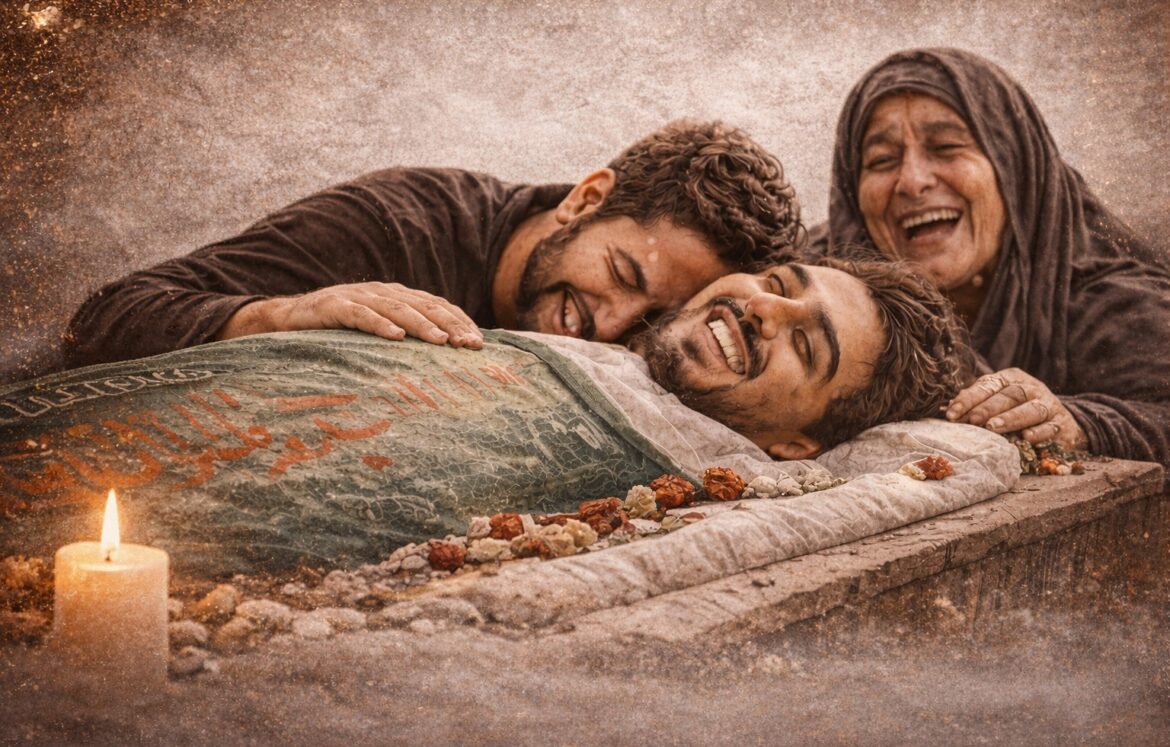
Hassan lay before me.
Life had left him. But his face still held its soft smile — as though he were now speaking to God the way he once spoke to me.
He had been killed under the pretext of “Shia–Sunni” conflict.
His full name was Syed Hassan Raza. He had been preparing for Nowruz that very day.
His killer was known — and unknown.
It was not a man.
It was an idea.
A slogan:
“Infidel, infidel — the Shia is an infidel.”
Inside, he lay motionless. Outside, I stood helpless.
Twenty years of living companionship had become a still body in a black suit.
Beside him was a small bag with my name on it.
“Our Twenty Years of Friendship.”
Inside was a photograph — two dust-covered boys laughing. Our school memory.
He had printed it for our meeting.
Masked men had asked his name.
Then shot him.
The next morning was his funeral.
He loved white. So I wore white.
But everyone else wore black.
Some spoke of revenge. Some muttered prayers. Some declared that justice required a Sunni life in return.
In that moment, I forgot I was Sunni.
I was simply a lover of my friend.
As I approached the bier, suspicion grew.
Two young men stopped me.
“Who are you?”
“I am Hassan’s friend.”
“He’s dead.”
“Does death end friendship?”
Someone shouted:
“This is that shameless Sunni friend! Kill him! Settle the account today!”
They struck me.
A blow to the head. A kick to the back.
I fell face-first onto Hassan’s bier — as if he had called me to embrace him.
I clung to him and wept.
Even in death, he seemed to smile.
Then a thunderous voice rose — his mother’s.
“My Hassan is gone! Why are you beating my Hussein?”
She called me Hussein.
She stood like a shield before me.
She led me to him and said:
“Hassan, your little brother Hussein has come.”
Then she said something only a mother could say:
“Let everyone hear this — among Hassan’s mourners are not only Shias, but Sunnis as well.”
Years have passed.
But no evening passes without tears.
Tea tastes bland. Weekends grow heavy.
I see him sometimes — in memory, in mirrors, in sudden laughter.
Colleagues think I am losing my mind.
But this is not madness.
It is devotion.
One day my cousin came again.
“These infidels have crossed all limits,” he said. “Now they are targeting our scholars.”
I held his hand firmly.
“Stop issuing verdicts. If God has not declared them polytheists, who are you to do so? They believe in the same God and the same Messenger we do.”
He sighed.
“Whoever loves them will rise with them on the Day of Judgment.”
For the first time in a long while, joy stirred within me.
Good, I thought.
Then Hassan and I will rise together.
He left a pamphlet behind.
On its cover were the words:
“Infidel, infidel — the Shia is an infidel; whoever does not agree is one too.”
Then I understood.
Since I did not consider a Shia an infidel, I too was one in their eyes.
But truth be told…
My Hassan was indeed an infidel.
Because every one of his gestures was dangerously infidel-like.
I used to call him “infidel” with affection.
Never knowing that one day that word would take his life.
———————————————
Poem Written in Hassan’s Memory
Our companions of love have risen and gone,
Our laughter has fallen silent.
Shadows have gathered before our eyes,
We have wept ourselves thin.
Where shall we go now?
In which direction shall we search for you?
Hassan, this Ata has not forgotten you —
Though many years have passed.
Written by: Ata ur Rehman
Original Date: 22 February 2013
Revised Edition: 21 January 2026 – 2:15 PM
Kohistan Enclave, Pakistan
